|
| http://cdn.history.com/sites/2/2016/04/GettyImages-113492973-E.jpeg |
Sometime at the end of September, 1846, blacksmith John Gallagher of New York received distressing news about the United States’ war with Mexico, a conflict that would eventually carry him to the distant reaches of North America. Gallagher remembered when he heard U.S. General [Zachary] Taylor (1784-1850) “with his Regulars and Volunteers, had been so roughly handled by [General] Santa Ana’s men, in Mexico, I, then a young man under twenty-one, threw down my blanketing implements and joined Colonel Jonathan D. Stevenson’s First New York Regiment of Volunteers.”[1] Gallagher was likely referring to the Battle of Monterrey, fought from September 21-24, 1846. There U.S. forces under Taylor fought Mexican forces led by General Pedro de Ampudia (1805-1868) for control of the city of Monterrey, located in the northeastern state of Nuevo León, Mexico. After a series of skirmishes, both armies sustained high casualties. Taylor, with no formal ability to do so, negotiated a truce with Ampudia. During this two-month armistice, the Mexican Army was permitted to evacuate with their equipment in exchange for surrendering the city to Taylor. Had Taylor been bolder and eschewed a truce in favor of a forcing a decisive victory at Monterrey, the Mexican government likely would have been toppled, or at least would have been forced into favorable peace talks with the United States. But Taylor was not bolder at that moment and the war continued for another sixteen months.[2] It was this state of affairs that compelled young John Gallagher of New York to enlist in the United States Army.
The narrative of John Gallagher’s experiences in the U.S.-Mexico War come to us from a single source, his 1903 typescript letter Personal Reminiscences of the War in Upper and Lower California between the American and Native Troops. This unpublished letter was addressed to a family friend, Rt. Rev. Msgr. Joseph Gleason, who served as Pastor of the St. Thomas Aquinas Church in Palo Alto, California. Gleason had previously worked the U.S. Army as a chaplain during the Spanish-American War (1898), and was known for his lectures on history at nearby Stanford University, which may help explain why Gallagher submitted his reminiscences to him.[3]
Gallagher’s letter is valuable not only because its sheds light on first-hand experiences of an enlisted American soldier (especially in Baja California), but also because it complicates our understanding of American soldiers’ behavior and conduct with Mexican civilians during the war. Gallagher was neither a historian nor a published author, yet his candid memories nearly fifty years later offers the modern reader important insight into the “Forgotten War.” Of singular importance are Gallagher’s encounters with Californio and Mexican civilian populations and how those interactions contrasted with U.S. Army experiences elsewhere during the war.
The Mexican Army posed no existential threat to New York. What promoted Gallagher to risk life and limb in faraway Mexico? Like most Americans, he likely would have explained the justification for American involvement by alluding to President James K. Polk (1795-1849). Polk’s infamous 1846 message to Congress reasoned that war was thrust upon the United States because Mexico, as Polk claimed, “has invaded our territory and shed American blood on American soil.” Polk was referring to military engagements between American and Mexican forces over disputed borderlands in Texas between the Nueces River and the Rio Grande. This “defensive rationalization” veiled a deeper desire for a larger war which would enable the Polk to seize a much wider expanse of Mexico’s northern territories. Republic of Texas President Anson Jones (1798-1858) charged that Polk’s ultimate plan, in accordance with Manifest Destiny, was to annex Mexico alongside Texas and thus “avoid the onus of initiating an aggressive war to acquire California and other provinces of Mexico.”[4] Polk drew critical congressional support from Southern Democrats, many of whom supported westward territorial expansion and the geographic extension of slavery.
John Gallagher makes no mention of Manifest Destiny, the defense of American borders in Texas, the “justifiable” U.S. acquisition of Mexican provinces, or the potential expansion of slavery. Instead, he offered a simpler explanation for war’s allure. “Fired by a spirit of adventure,” he wrote, “the young men composing [the U.S.] army had abandoned homes, trades and professions to enroll under the standard of the Colonel [Jonathan D. Stevenson (1800-1894)].” The adventure seeking New York Regiment soon boarded the Thomas H. Perkins, which alongside the Loochoo and Susa Drew, had been called to reinforce the U.S. Navy’s “Pacific Squadron” in Alta California. Rounding Cape Horn, Gallagher arrived in San Francisco over six months later. The city’s humble appearance did not temper the soldiers’ patriotic arrival. “The principle settlement of Yerba Buena, the San Francisco of present day,” Gallagher observed, “was at Portsmouth Square. A small collection of adobe houses was around the enclosure, and a liberty pole stood in the center, with the stars and stripes flung to the breeze.”[5] After resupplying, Gallagher’s regiment boarded a smaller ship for a trip down the coast to Santa Barbara.
 |
| Figure 1: The Thomas H. Perkins, circa 1837.[6] |
Locating the Enemy
Upon arrival in Santa Barbara, local Californio women and children threatened the U.S. troops, ominously warning that General Castro “was coming to cut [their] throats.” Gallagher assures the reader that their throats remained whole for a while longer as Castro failed to make an appearance. Gallagher is referring to José Antonio Castro (1808-1860), one time acting governor of Alta California and later Commadante General of the Mexican Army from the time of the “Bear Flag Revolt” in June, 1846. Castro was outraged by the U.S. policy of military aggression in Alta California. Earlier that summer Castro denounced “the contemptible policy of the United States” who had “induced a portion of adventurers [led by U.S. Major John C. Frémont (1813-1890)] who…have daringly commended an invasion. The defense of our liberty, the true religion which our fathers possessed, and our independence, calls upon us to sacrifice ourselves.”[7] As Gallagher was soon to discover, the lines that separated friend from enemy proved to be less than clear.
American troops arrived in Santa Barbara expecting a fight, but instead encountered civilian preparations for the Feast of Corpus Christi, a Catholic celebration of the Eucharist. The commander of Gallagher’s 1st Regiment of New York Volunteers, Lt. Col. Henry Stanton Burton (1819-1869), instructed the troops that “[we] have nothing to do with the religious sentiment of the people, but it only proper that we show becoming respect for the faith of our enemies.”[8] Gallagher noted the soldiers saluted the “beloved Padres” and as several the soldiers were Catholic, some even attended the church service. This moment of social amity was critical for the way Gallagher would remember the war. Burton’s requirement that U.S. soldiers respect the “enemy” Californio civilian population had, in Gallagher’s view, long lasting consequences. The diplomatic actions of the soldiers changed “the sentiments of the people toward us,” Gallagher recalled. The Californios, he wrote, “pronounced the ‘Americanos’ to be ‘Gentleman and Christians,’ and from that day forth there was peace and good-will between the natives of Santa Barbara and ourselves.”[9] This event stood as an important precursor to the 1st Regiment of New York Volunteers’ experiences throughout the war.
Leaving Santa Barbara, the regiment marched to Mission San Buenaventura to deliver ammunition to troops stationed there. On the way, they came across stragglers returning from Los Angeles who had been discharged without payment from Frémont’s army and were making their way up to Monterey. They informed Gallagher’s men that American forces stood in imminent danger of being attacked in Los Angeles, the regiments’ new destination. It was there Gallagher encountered the Mormon Battalion. “Upon our arrival,” he wrote, “we found a battalion of Mormons, recently arrived. They appeared to be good men and fine soldiers.”[10] While bigotry against Mormons was common in the United States, Gallagher appreciated not only their helpful assistance, but their soldierly comportment. Like Santa Barbara, however, there was no battle awaiting. Leaving Los Angeles, Gallagher embarked on the ship of the line, the USS Lexington, bound for La Paz, Baja California, where the war was being fought in earnest.
_off_Smyrna_by_Corsini.jpg/300px-USS_Lexington_(1825)_off_Smyrna_by_Corsini.jpg) |
| Figure 3: USS Lexington, circa 1825.[11] |
From Alta to Baja California
Gallagher and the army landed in La Paz, Mexico, although by that time the main U.S. force was reduced from three to two companies. The army examined an abandoned citadel nearby, but not finding it to their liking, took over a local church and made camp. During an ensuing battle with Mexican forces, Gallagher wrote again on the fundamental difference between the Mexican military and civilian populations. The military are unequivocally the “enemy” while the Mexican civilians, in Gallagher’s estimation, seem to “prefer” the governance of the United States. One such instance occurred following a round of shelling between American and Mexican armies near La Paz. Gallagher observed how the “Governor, the Alcalde, and other prominent citizens swore allegiance to our government and came to live with us in our camp.”[12] While these citizens were technically the enemy, war-time exigencies turned erstwhile enemies into practical allies. Little of this goodwill was extended by American officials to Californio populations after the war, but on this point Gallagher is silent. When U.S. reinforcements arrived from Alta California, the U.S. army, with Gallagher’s approval, “forthwith turned the place [the army camp] over to our new friends.”[13] The invading army, at least in Baja California, was doing its level best to win over the sentiment and allegiance of the local population.
Gallagher’s regiment heard from some American stragglers that U.S. prisoners were being held at a Mexican citadel in San Antonio, home to some 600 soldiers. A group of thirty men, including Gallagher, blatantly defied orders and headed out to San Antonio to free their comrades. Utilizing the element of surprise, they successfully freed the prisoners. Energized, the U.S. troops also took Mexican prisoners, a captain and a lieutenant, but the biggest prize alluded them. “Our next attempt was to take General Panada [Colonel Manuel Pineda Munoz (1804-1891)], but our search for the brave commander proved fruitless. We afterward understood he had taken refuge in a bake-oven.”[14] Just as Gallagher takes every opportunity to compliment Mexican civilians, he typically characterized the Mexican Army with bemusement or disdain.
After the rescue from San Antonio, Gallagher’s troops hurried back to camp in La Paz. There they engaged with Pineda’s men in the Battle of Todos Santos, which proved to be both the end of hostilities in Baja California and the last significant engagement of the war. While marching toward the Mexican Army, the U.S. soldiers came to the small town of Todos Santos where “with no opposition from the inhabitants, [they] took possession of the church and the buildings.”[15] Once again, Gallagher’s regiment conspicuously avoided potential violence with the local population.
Due to excessive marching in the torrid weather, the army’s horses were too tired to proceed. A commanding officer suggested a requisition of horses from the local padre. Gallagher learned the padre had “belonged to one of the first families of the peninsula.” “In this youth,” Gallagher added, “[the padre] had been educated for [the] priesthood, but it soon became evident that the vocation was lacking [as later] he evinced such evil propensities that he became an object of terror and hatred throughout the country.”[16] Despite this unsavory reputation, he was nevertheless styled as “padre” by the local people and servants under his employ. Gallagher’s lieutenant asked the padre for fresh horses. The padre dithered and complained that he had none to offer. The lieutenant replied that his soldiers would patiently wait and avail themselves to the padre’s goods. Wasting no time, a sergeant found “a large receptacle filled with liquor, which he distributed among [the regiment’s] thirty men, and to those of the household who stood near.”[17] This act, to Gallagher’s reckoning, reflected how the U.S. Army were less imperial conquerors than friendly liberators.
The day after seizing the liquor, Gallagher and his men insisted the padre’s servants help themselves to the ill-gotten goods of their master’s house. In the padre’s provision stores the soldiers found ample quantities of green cheese and brown sugar cookies, both of which had been manufactured by the servants, but never made available to them. Gallagher recalled that “we generously urged the natives to help themselves to all they wanted, as everything was ours, we assured them, knowing as we did that nothing could have induced them to touch anything belonging to their master, the ‘Padre,’ as they invariably styled him.”[18] Another instance, Gallagher proudly cited, of liberal American generosity. What may seem like minor incidents between the U.S. Army and local civilian populations contrasted drastically with other theaters of war in Mexico.
Finally able to procure fresh horses, the despondent padre helplessly watched as part of the regiment left for battle while others continued to garrison his town. Gallagher wrote approvingly of the “commendable” behavior of the American soldiers while stationed in Todos Santos. “They left a good record,” lauded Gallagher, “for they disturbed nothing belonging to the people.”[19] Separating the belongings of the people from those of the padre required no leap in logic for either the U.S. Army or Gallagher the chronicler. In his view, it would have been all too easy for the invading American army to “disturb” valuables belonging to “the people.” In Todos Santos, Gallagher remembered that in “the church hung valuable paintings brought from Old Spain hundreds of years ago.” “These masterpieces,” he recorded, “were left none the worse by even so much as a scratch from any of our men.”[20] As to whether this was the particularly meritorious behavior of the 1st New York Regiment, or common practice among the larger army contingent in Baja California, Gallagher does not say.
Even among these well-behaved troops, not all were above the allure of plunder. Gallagher included a counterexample of dishonorable behavior. Ultimately victorious in a battle near La Paz which saw “General Panada” [Captain Manuel Pineda Munoz] captured, discomfiting news greeted Gallagher as “tidings from San Antonio…gave us considerable concern. They were to the effect that the church had been robbed, and although the natives gave us assurances to their belief that no American soldier had had a hand in the affair, we nevertheless regretted to learn of the sacrilege, and made efforts to discover the culprit.”[21] Gallagher could have omitted this event, but he presumably wanted to acknowledge that individual outliers were not representative of his regiment. Moreover, the power of American justice was given an opportunity at San Antonino to show its quality. The culprit turned out to be deserter from the U.S. Army. The thief had attempted to befriend a fellow soldier, offering to divide the realized value of the plunder in exchange for assistance with smuggling it back into the United States, but the thief was instead revealed to military police. After a three-day trial, the location of the stolen goods was discovered, the deserter found guilty and banished from camp, and the property restored to its rightful ownership to the church.
One Adventure Ends, Another Begins
This instance proved to be last chapter of the war as peace was soon thereafter declared following the signing of the Treaty of Guadalupe Hidalgo on February 2, 1848. Gallagher proudly reported that his 1st Regiment of New York Volunteers held Alta and Baja California from March, 1847 until the end of hostilities. Gallagher then boarded the USS Ohio at La Paz to make the trip north to an Alta California that was now annexed (as Anson predicted) to the United States.
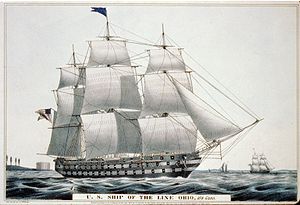 |
| Figure 4: USS Ohio, circa 1848.[22] |
Leaving La Paz was something of a mixed blessing. Glad to know the war was over, the future political status of the local citizens of Baja California vexed Gallagher. “The people we had come to conquer,” he wrote, “regretted that our government had relinquished Lower California.”[23] Many of the leading Mexican citizens of the area, whom Gallagher now considered his friends, accompanied the army to Monterey. Even as war segued to peace, Gallagher’s penchant for being present at pivotal historical moments continued. As the Ohio pulled into Monterey, California, recent news that gold had been discovered in Coloma at Sutter’s Mill moved like electricity through the ship. The soldiers no sooner having been discharged and “settled up” with Uncle Sam, “exchanged the musket for the pick and shovel.”[24] Gallagher makes no mention of his adventures in searching for gold, but he did stay in California for the remainder of his life, recording his occupation as “farmer” in an application to the California Society of Pioneers decades later.
The end of John Gallagher’s Reminiscences details a selection of soldiers he fought with who went on to notable careers as politicians, surveyors, and leading officers in the American Civil War. True to his narrative arc, Gallagher returned once more to his fond memories with the Mexican civilian populations he encountered. “From the natives, we received the kindest treatment,” he recalled. “Never pausing to inquire as to one’s religion or nationality, they provided good nurses in sickness, and would at any time, divide their last tortilla with us.” “In all my time with them,” he adds favorably, “I never saw one intoxicated.”[25] A final anecdote of his regiment’s behavior is worth noting. Gallagher recalled that inside the church at La Paz, upon the statue of the Virgin Mary, was a string of pearls worth “at least $900.00” (roughly $26,000 in 2016 dollars). Despite being stationed at this church for over three weeks, and having every opportunity, “no one dreamed of touching the necklace, or anything else belonging to the people…More might be added to what I have written,” Gallagher wistfully concluded, “but perhaps in this modern day few will care with me to lift the curtain of half a century.”[26] John Gallagher would be pleased to know that historians today care deeply about lifting the curtain of time, with his letter serving as a critical window into the often forgotten past of the U.S.-Mexican War.
Conclusion
Modern readers might scoff at Gallagher’s purple prose regarding his regiment’s experiences with Mexican civilian populations. Surely, the justification of western imperialism has ever been to “uplift” indigenous people by supplanting and replacing tyrannical leaders only to exploit their resources and people afterward. However, I do not think an imperialist project can be justifiably read into Gallagher’s letter. He sought adventure and opportunity rather than “civilizing uplift” or conquest and made it a point how well Mexican civilians were treated by his regiment throughout. It was evident that the army’s commendable behavior in Baja California be remembered by posterity.
The significance of respecting the enemy’s religion and culture was more than just the practice of Gallagher’s regiment, however. As historian David Cleary has shown, President Polk possessed a “disgust” for religious bigotry. “Polk,” Cleary argues, “wanted to relieve Mexican fears about threats to their religion, and asked Archbishop John Hughes to persuade Mexicans that there were no ‘hostile designs [by the U.S.] on their religion’.”[27] The leading American military commander, General Zachary Taylor, also worried about the implied threat of a “holy war” between the largely Protestant United States against Catholic Mexico. Taylor had a proclamation distributed throughout Mexico which stated, “Your religion, your altars, and churches, the property of your churches and citizens, the emblems of your faith, shall remain inviolate.” The proclamation assured Mexicans of the U.S. government’s sincerity as “hundreds of our [army], and hundreds of thousands of our people are members of the Catholic Church.”[28] John Gallagher was an Irish immigrant, although we can only infer his affiliation to Catholicism.[29] The dominant faith of any given U.S. Army unit appears to be the determining characteristic in how Mexican civilian populations were treated during the war. Clearly argues that Catholics may have made up a majority of the enlisted army (which Gallagher was part of), while the volunteer army units were nearly all Protestant. The atrocities committed by many of the Protestant volunteer units were legion, as they “devoted special attention to the Mexican Church, robbing and killing priests, raping nuns, looting altars, and desecrating holy buildings.”[30] While Taylor issued orders against this kind of behavior, little was done within the army to stop it. Polk’s volunteer armies “inspired lingering hatred in Mexico toward los Gringos malditos (damned Gringos).”[31] Further complicating the politics of religious affiliation was the infamous San Patricios Battalion, composed mostly of Catholic deserters from the United States Army, many of whom were born in Ireland. Following the Battle of Churubusco in August, 1847, over seventy of the St. Patrick’s Battalion were captured by U.S. forces and tried for treason. Fifty of those tried were executed by hanging. Their leader and founder, John Riley (1817-1850), had his sentence commuted, but was branded with a “D” on his face (for deserter) and received fifty lashes across his back. Undaunted, Riley later rejoined the Mexican Army and reformed the San Patricio’s Battalion, whose service remains celebrated in Mexico today.[32]
Of significant value to future historiography of the U.S.-Mexican War would be a demographic analysis of the U.S. Army soldiers’ religious backgrounds and their deployment alongside a comparative analysis of Mexican perspectives on the behavior of the U.S. Army during the war. In which cases did Catholic and Protestant affiliation correlate to wartime atrocities? Problematizing the United States’ conduct, on what is understood today to be an unabashedly aggressive war for empire, can help contextualize the differential lived experience of American soldiers and Mexican civilian populations. Gallagher’s 1st Regiment of New York Volunteers, who collectively took Polk and Taylor’s wartime proclamations to heart, may serve as an indicator of larger transnational Protestant and Catholic sectarian strife within the U.S. Army as it played out across the battlefields of Mexico.
---------------------------------
[1] John Gallagher, Personal Reminiscences of the War in Upper and Lower California between the American and Native Troops, (Typescript: 1903), 2. BANC MSS 71/186c, Bancroft Library, University of California, Berkeley. 21 February 2017.
[2] Joseph Wheelan, Invading Mexico: America’s Continental Dream and the MexicanWar, 1846-1848 (New York: Carrol and Graf Publishers: 2007), 199.
[3] “Father Gleason to Lecture Tuesday,” accessed March 12, 2017, stanforddailyarchive.com, Stanford Daily, Volume 52, Issue 3, 4 January 1918: http://stanforddailyarchive.com/cgi-bin/stanford?a=d&d=stanford19180104-01.2.9&e=-------en-20--1--txt-txIN-------#
[4] Glenn W. Price, Origins of the War with Mexico: The Polk-Stockton Intrigue (Austin: University of Texas Press, 1967), vii.
[5] Gallagher, Personal Reminiscences, 2.
[6] “Legendary Ships of Salem,” accessed March 12, 2017, https://storiesfromipswich.org/2015/07/11/legendary-ships-of-salem/.
[7] David A. Clary, Eagles and Empire: The United States, Mexico, and the Struggle for Empire (New York: Bantam Books, 2009), 91.
[8] Gallagher, Personal Reminiscences, 3.
[9] Ibid.
[10] Ibid., 4.
[11] “Sloop-Of-War USS Lexington (1825),” retrieved March 18, 2017, http://www.waymarking.com/waymarks/WMT51F_Sloop_Of_War_USS_Lexington_1825_Lexington_MA
[12] Gallagher, Personal Reminiscences, 10.
[13] Ibid., 11.
[14] Ibid., 14.
[15] Ibid., 18.
[16] Ibid., 19.
[17] Ibid., 20.
[18] Ibid.
[19] Ibid.
[20] Ibid
[21] Ibid., 26
[22] “U.S. Ship of the Line Ohio, 104 Guns,” accessed March 18, 2017, http://www.navsource.org/archives/09/86/098600801.jpg.
[23] Gallagher, Personal Reminiscences, 27.
[24] Ibid.
[25] Ibid., 32.
[26] Ibid.
[27] David A. Clary, Eagles and Empire, 141.
[28] Ibid.
[29] Gallagher’s application to the Society of California Pioneers records indicates that he was born in Ireland in 1804 (Online Archive of California) http://www.oac.cdlib.org/findaid/ark:/13030/c8xk8d8b/entire_text/. Measured against the Gallagher family friendship with Father Gleason at the Palo Alto Church of St. Thomas Aquinas strongly suggests Gallagher identified at least culturally as Catholic.
[30] David A. Clary, Eagles and Empire, 141. See also: Ted C. Hinckley, “Anti-Catholicism during the Mexican War,” Pacific Historical Review 31 (May 1962): 121-138.
[31] Ibid.
[32] Christopher Conway, “U.S. and Mexican Accounts of the Execution of the San Patricios (September 10-13, 1847),” in The U.S.-Mexican War: A Binational Reader, ed. Christopher Conway (Indianapolis: Hackett Publishing Company, 2010), 95-96.