Showing posts with label citizenship. Show all posts

Thursday, October 20, 2016

Reviewed: Eric Foner’s A Short History of Reconstruction, 1863-1877


Foner, Eric. A Short History of Reconstruction, 1863-1877. New York: Harper Perennial, 1990. Pp. 297.

T
he story of the Civil War has captivated Americans for generations. It is perhaps the one historical event, along with the American Revolution, that remains foregrounded in collective memory. Most Americans tend to celebrate the grand personalities of the era and the valor displayed on memorialized battlegrounds more than the war’s causes and legacies. If the story of the Civil War has remained alive through public memory, then the consequences of the war, the era of Reconstruction, have largely been forgotten. Without the obvious framing of pitched battles and heroic sacrifice, the sometimes noble, sometimes violent, but always complicated story of the readmittance for Confederate states into the Union has gotten short shrift.

Eric Foner, DeWitt Clinton Professor of History at Columbia University, is arguably the preeminent Reconstruction historian  today. His 1990 publication, A Short History of Reconstruction, 1863-1877, is among the landmark examinations of the post-Civil War era. The first systematic study of Reconstruction, by William Dunning (also of Columbia University) in the early twentieth century, condemned Reconstruction policy as a failure because of the twin problems of the corruption of Republican rule and black political incompetence and malfeasance. This failure was corrected, the story went, when the South was “redeemed” by the Democratic Party (with help from the Ku Klux Klan) and blacks were relegated to second-class citizenship. Modern scholarship has repudiated this theory as racist and incomplete. Unlike the Dunning School, modern scholars, especially since the 1960s, have tended "to view emancipation itself as among the most revolutionary aspects of the period” (xiv). To that end, The Short History of Reconstruction presents four unifying themes: 1) the centrality of the black experience, 2) the ways Southern society as a whole was remodeled, 3) the evolution of racial attitudes and patterns of race relations and the complex interconnection of race and class in the post war South, and 4) the emergence of the modern nation-state. 

Professor Eric Foner
Source: https://www.college.columbia.edu

The South, Foner indicates, was “…never a single white [community]; in the nineteenth century, the region as a whole, and each state within it, was divided into areas with sharply differing political economies” (5). While most states were led by a conservative planter elite, some non-slave owning white yeoman farmers welcomed political reform, but nearly all whites were united in their repugnance of black suffrage. This indicates why northern Republicans initial, if limited, success in integrating blacks into the political community was eventually repulsed by an overwhelming wave of white supremacy and growing northern disinterest in combating political violence.

Blacks, as Foner argues, were not invisible or passive observers of Reconstruction. Emancipation was only the first step in building an independent black community through the reuniting of family members previously separated by slavery. Black men then looked to reclaim authority in family affairs long dominated by slave-owners. Outside the family, black-led churches became the central institution of the freed community. There blacks could discuss issues like education and land reform that predicated their collective vision of freedom. Lastly, political mobilization into the Republican Party was of paramount significance. The Republican Party, Foner argues, “…became an institution as central to the black community as the church and the school. Long after (blacks) had been stripped of the franchise, blacks would recall the act of voting as a defiance of white superiority and regard ‘the loss of suffrage…as the loss of freedom’” (128).

There were two reasons why the North could intervene so comprehensively in the political and social life in the South: the South was in shambles after the Confederacy’s collapse in 1865; and there had been an unprecedented expansion of federal authority wrought by the exigencies of the Civil War. “The federal budget,” Foner argues, “amounting to $63 million in 1860, rose to well over $1 billion by 1865. At war’s end the federal government…was the largest employer of the nation” (10). Armed with these enhanced human and fiscal resources, the federal government worked to rebuild the South’s economy and society through the policies of the Radical Republicans in Congress. 

The antebellum federal government rarely waded into political issues such as citizenship and equality as they were thought to belong to state jurisdiction. After Lincoln’s assassination, Andrew Johnson, a southern sympathizer and avowed racist, became president. He proposed to readmit the Confederate states as quickly as possible with little concern for the well-being of millions of former slaves freed by the Thirteenth Amendment. Eventually this drew the ire of northern Republicans who thought this would mean the war had been fought in vain. Overriding Johnson’s veto power, the Radical Republican faction of Congress worked to completely overhaul Southern society by making it an interracial democracy. By 1877, however, the waning power of the Radical Republicans, the resistance of Southern whites, and the eventual indifference of Northern whites to the plight of blacks, indicated declining support for Reconstruction. An “official” end to Reconstruction is typically associated with the contested presidential election of 1876 between Republican Rutherford B. Hayes and Democrat Samuel J. Tilden, the latter of whom won the popular vote but controversially lost the electoral vote. Eventually a deal was struck between Democrats and Republicans in Congress where Hayes would take the presidency in exchange (among other things) for the removal of all U.S. forces from the South, and with them the protection of Republican state governments and the return of the overtly racist Democratic Party to local and state power.

“Despite all its limitations,” Foner maintains, “Congressional Reconstruction was indeed a radical departure, a stunning and unprecedented experiment in interracial democracy” (122). Radical Reconstruction, that combined effort by white and black Americans in the South to give African-Americans political power and economic security, retreated in significance as most Americans became more concerned with economics than social equality. The end of slavery, it was argued, was all the federal government owed to blacks. Economic concerns, for all races, ought to be left to the market. To this end, the Democratic Party consolidated control by limiting access to political power on strict class-based criteria. “[The] return to [southern] rule by ‘intelligent property-holders’,” Foner writes, “meant the exclusion of many whites from government, while implicitly denying blacks any role in the South’s public affairs except to vote for their social betters” (182). Crippled by the rampant violence perpetrated by white supremacist groups such as the Ku Klux Klan, the once “noble” experiment of Reconstruction morphed into the rigid apartheid of Jim Crow inequality.

Foner argues this process played out against a backdrop of increasingly vocal classical liberals during the 1870s. Classical liberalism was predicated on limited state intervention, since the rampant corruption of the time, especially in the South, was presumed to be the result of excess governmental interference in the marketplace. Without land and labor reform, blacks would be left powerless and dependent, and most southern whites agreed this was “natural.” “Nearly all [these classical liberal] reformers,” Foner observes, “had been early advocates of emancipation and black suffrage…[yet] if all Radical [Republicans] agreed the state should embrace the principle of civil and political equality, liberals increasingly insisted it should do little else” (210).           

The realization of full citizenship and economic access and opportunity was denied to blacks at the close of Reconstruction, and in that respect, Foner concludes, the process can only be judged a failure. It was a failure not because Republicans erroneously or vindictively elevated blacks—and working class whites—in the South (as Dunning had argued), but rather because the counter-revolution of exclusionary “home-rule” by the Democratic Party set into motion decades of racial inequality. Nonetheless there were some aspects of accomplishment. “The tide of change” Foner notes, “rose and then receded, but it left behind an altered landscape. The freedman’s political and civil equality proved transitory, but the autonomous black family and a network of religious and social institutions survived the end of Reconstruction” (254). By giving agency to and centralizing the experiences of blacks alongside whites in the narrative of Reconstruction, Foner’s work yields a comprehensive history of the revolutionary and pivotal time following the Civil War. His work remains critically important because the legacy of Reconstruction, with its central challenge of interracial democracy, still resonates today.


Tuesday, February 9, 2016

Without Consent of the Governed: Frederick Douglass and the 4th of July


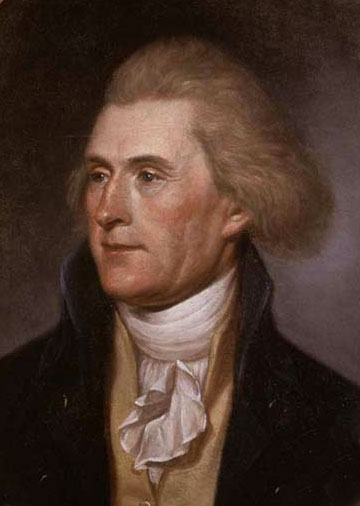
Thomas Jefferson, 1791.
(from https://upload.wikimedia.org/wikipedia/commons/4/46/T_Jefferson_by_Charles_Willson_Peale_1791_2.jpg)

In the United States, the 4th of July is celebrated each year as the momentous founding of the country from its revolutionary inception in 1776. The Declaration of Independence, arguably the most hallowed document in the civic religion of America, gave voice to the rebellious colonists who rejected British dominion. Among the arguments the colonists presented for declaring independence was the notion of where governments justly derive their powers. Thomas Jefferson argued in the Declaration that in order to secure the self-evident rights of “Life, Liberty and the pursuit of Happiness,” governments specifically derive “…their just powers from the consent of the governed.” “That whenever any Form of Government becomes destructive of these ends,” he concludes, “it is the Right of the People to alter or abolish it, and to institute a new Government.” Although the argument that all men were created equal was more Enlightenment infused rhetorical flourish than reconcilable reality with the peculiar institution, the 4th of July became a country-wide celebration of the triumph of liberty over political “slavery” to Britain.[1]


Frederick Douglass, circa 1874.

(From George Kendall Warren [Public domain], via Wikimedia Commons)

One person who did not share in this celebration of the 4th of July was Frederick Douglass. Douglass was born into slavery around 1818 in Maryland, and as a young boy was sent to work in the home of Hugh Auld in Baltimore. Douglass, notably, was of a mixed race background, although this was not uncommon or even incompatible with racial slavery in America. The infamous “one-drop” rule was all that needed to qualify as “black.”[2]

Sophia Auld, the wife of Hugh Auld, secretly taught young Frederick the alphabet. An enterprising Douglas continued developing his literacy with white children in his neighborhood and through newspapers like the Colombian Orator.[3] After nearly being psychologically broken working for an abusive “slave-breaker” named Edward Covey, Douglass made up his mind to escape to the northern states. He successfully accomplished this in 1838 with the help of a free black woman named Anna Murray, with whom he later married and settled down with in New Bedford, Massachusetts, where there was already a considerable free black community.


Anne Murray, 1860?
(From https://commons.wikimedia.org/wiki/File%3AAnna_Murray-Douglass.jpg)

Soon after, Douglass developed his role as an abolitionist of slavery through his speeches around New England and the publication of his remarkable autobiography, Narrative of the Life of Frederick Douglass, an American Slave, in 1845. The next two years he spent abroad in Britain avoiding the danger of recapture due to his new found celebrity. It was there where he gave speeches to enthusiastic crowds about the evils of American slavery (Britain had outlawed slavery in 1833). His popularity enabled the purchase of his freedom and the eventual return to America to continue his calls for the abolition of slavery.

It was during time in 1852, at an abolitionist meeting in Rochester, New York, that Douglass gave one of the his most famous speeches. Douglass was asked to speak at a convention commemorating the 4th of July of that year. In the beginning of his speech, Douglass announced: “Fellow Citizens, I am not wanting in respect for the fathers of this republic. The signers of the Declaration of Independence were brave men. They were great men, too, great enough to give frame to a great age. It does not often happen to a nation to raise, at one time, such a number of truly great men. The point from which I am compelled to view them is not, certainly, the most favorable; and yet I cannot contemplate their great deeds with less than admiration. They were statesmen, patriots and heroes, and for the good they did, and the principles they contended for, I will unite with you to honor their memory...”[4]

For what did this noble independence bring to the slave? The idea of a newly minted American government, having successfully wrested power from the British, and being justly conferred power by the “consent” of the governed, sat rather uncomfortably with the reality of slavery. What could Douglass rightfully commemorate or celebrate? Douglass lamented that while there is understandable revelry from free whites of America over the glory of independence, the 4th of July is in fact the opposite to the slave—a time of misery. He explained to his Rochester audience: "Your high independence only reveals the immeasurable distance between us. The blessings in which you, this day, rejoice, are not enjoyed in common. The rich inheritance of justice, liberty, prosperity and independence, bequeathed by your fathers, is shared by you, not by me. The sunlight that brought light and healing to you, has brought stripes and death to me. This Fourth July is yours, not mine."[5]


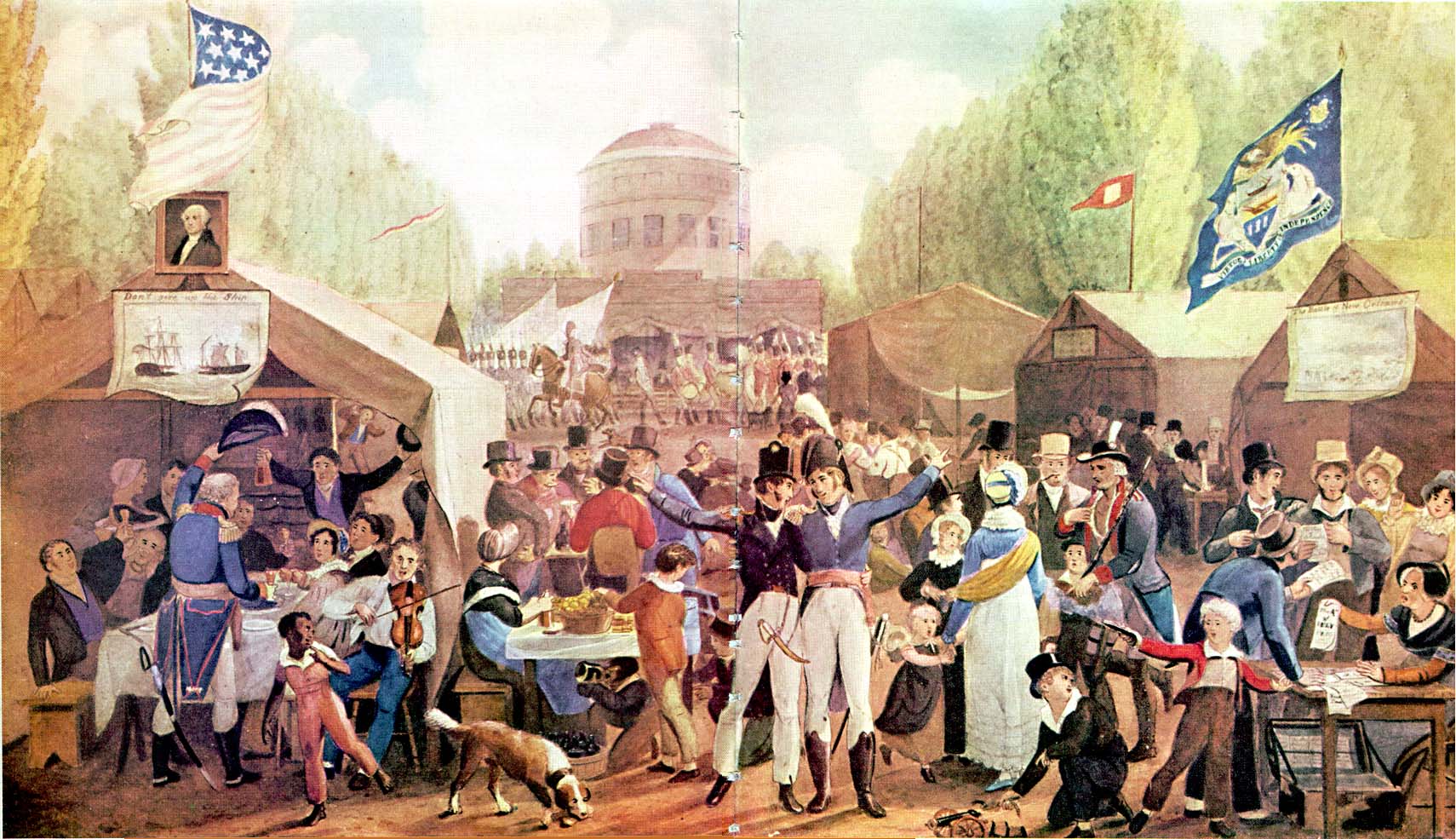
John Lewis Krimmel's "Fourth of July Celebration in Centre Square, Philadelphia (1819)"
(From John Lewis Krimmel [Public domain], via Wikimedia Commons

Slaves, by not having given consent—either to their masters or their “representative” government—were thus completely excluded from the nation’s republican experiment in liberty and from any celebration of independence. Beyond that, as Douglass needed to point out, the celebration was an insult to the continuing injuries and humiliations of slavery, a time to mourn for those in chains.

So what, Douglass then asked, did the 4th of July really mean to a slave? He provided an answer: "a day that reveals to him, more than all other days in the year, the gross injustice and cruelty to which he is the constant victim. To him, your celebration is a sham; your boasted liberty, an unholy license; your national greatness, swelling vanity; your sounds of rejoicing are empty and heartless; your denunciation of tyrants, brass fronted impudence; your shouts of liberty and equality, hollow mockery; your prayers and hymns, your sermons and thanksgivings, with all your religious parade and solemnity, are, to Him, mere bombast, fraud, deception, impiety, and hypocrisy -- a thin veil to cover up crimes which would disgrace a nation of savages. There is not a nation on the earth guilty of practices more shocking and bloody than are the people of the United States, at this very hour."[6]

As journalist and cultural studies lecturer Gregory Stephens argued, Douglass presented the United States as being imbued with “irreconcilable doubles.” He wrote, “[Douglass’] contrast between July 4 and not-July 4 initiated a radical critique of American citizenship, symbolized by a series of seemingly irreconcilable doubles: white and black, American and not American, free and not free, celebration and mourning.”[7]

Yet, in light his own brutal experiences as a slave, the stark reality of millions of slaves suffering in the United States, and all those seemingly irreconcilable binary contrasts, Douglass was ultimately encouraged by the abolitionist spirit of the age. The destiny of slavery in America, he felt, was at hand. At the close of his speech, he remarked: “...Allow me to say, in conclusion, notwithstanding the dark picture I have this day presented, of the state of the nation, I do not despair of this country. There are forces in operation which must inevitably work the downfall of slavery…While drawing encouragement from ‘the Declaration of Independence,’ the great principles it contains, and the genius of American Institutions, my spirit is also cheered by the obvious tendencies of the age.”[8]

Douglass would of course live to see the end of slavery in America as part of the series of consequences of the American Civil War that began just nine years later. But on this day, July 5, 1852, Frederick Douglass asked his audience to think critically about those American ideas and institutions of independence being celebrated the day before. Douglass’ vision looked beyond the fenced in racial duality of white and black (no doubt influenced by his own multiracialism) and saw a “third space” where the ideal of unity might one day reside. “Even at his most oppositional, as in the July 5 Speech,” Gregory argued, “Douglass affirmed a foundational interrelatedness.”[9] Perhaps it is in this interrelatedness where Douglass foresaw the 4th of July as a celebration by all in the fullest spirit of independence, where all Americans were in principle and in fact free and that their government would have the just consent of all its people. One wonders if Douglass would be cheered on by the obvious tendencies of our current age?

                                              _______________________________________


[1] “Peculiar institution” was a common euphemism for slavery.
[2] Davis, James F. “Who is Black? One Nation’s Definition.” [http://www.pbs.org/wgbh/pages/frontline/ shows/jefferson/mixed/onedrop.html] Davis wrote, “[the] term "mulatto" was originally used to mean the offspring of a "pure African Negro" and a "pure white." Although the root meaning of mulatto, in Spanish, is "hybrid," "mulatto" came to include the children of unions between whites and so-called "mixed Negroes." For example, Booker T. Washington and Frederick Douglass, with slave mothers and white fathers, were referred to as mulattoes. To whatever extent their mothers were part white, these men were more than half white. Douglass was evidently part Indian as well, and he looked it.”
[3] http://www.biography.com/people/frederick-douglass-9278324#synopsis
[4] Douglass, Frederick, "The Meaning of July Fourth for the Negro." The Life and Writings of Frederick Douglass, Volume II Pre-Civil War Decade 1850-1860. S. Foner, Philip. New York, International Publishers Co., 1950. [http://www.pbs.org/wgbh/aia/part4/4h2927t.html].
[5] Ibid.
[6] Ibid.
[7] Stephens, G. (1997). Frederick Douglass' multiracial abolitionism: "antagonistic cooperation" and "redeemable ideas" in the July 5 speech. Communication Studies, 48(3), 175-194. Retrieved from http://search.proquest.com/docview/233193281?accountid=458
[8] Douglass, Frederick, "The Meaning of July Fourth for the Negro." The Life and Writings of Frederick Douglass, Volume II Pre-Civil War Decade 1850-1860. S. Foner, Philip. New York, International Publishers Co., 1950. [http://www.pbs.org/wgbh/aia/part4/4h2927t.html].
[9] Stephens, G (1997). Frederick Douglass' multiracial abolitionism: "antagonistic cooperation" and "redeemable ideas" in the July 5 speech. Communication Studies, 48(3), 175-194.